Buying Guides
Why large-scale ocean canvas prints make a statement in open-plan living spaces
Auraveli Editorial ·
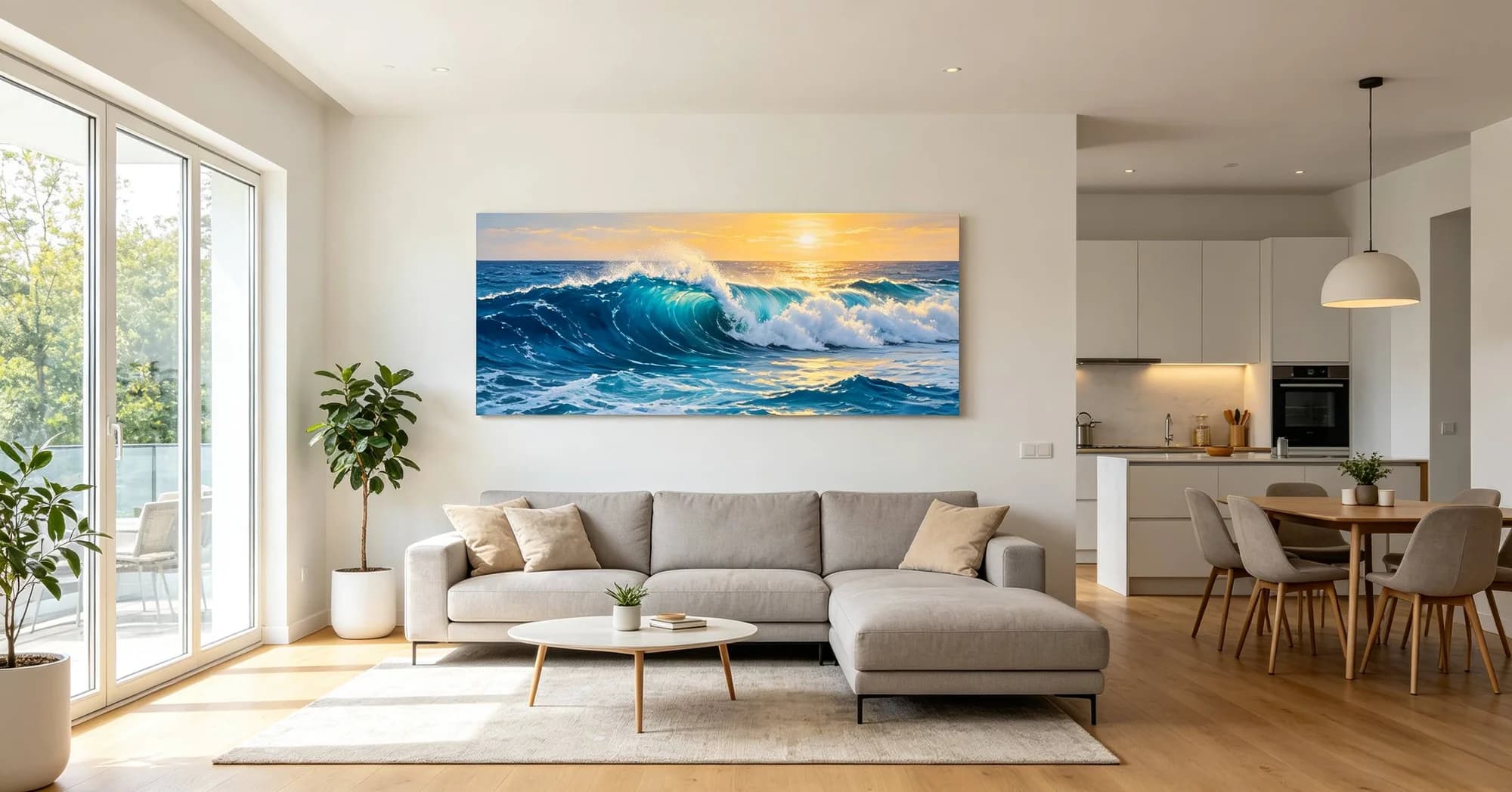
Large ocean canvas prints anchor open-plan rooms through scale and placement; conservation and building science guide lighting, humidity, and material choices.
Large-scale ocean canvas prints make a statement in open-plan living spaces by serving as a dominant focal point that anchors the room's visual composition. The key decision criterion is scale relative to the wall and surrounding furniture, not just the image itself. Evidence boundaries: while aesthetic impact is subjective, practical guidance on placement, lighting, and environmental protection comes from conservation and building science sources, which we cite throughout.
Scale and Proportion: Why Big Works in Open-Plan Rooms
In an open-plan room, the wall often spans a wide area, and a small print can get lost in the visual noise of multiple zones. A large canvas, by contrast, creates a clear anchor that draws the eye and defines the space. The decision hinges on proportion: if the wall is wider than the sofa, the usual guidance of matching art to furniture width no longer decides the question on its own; instead, the art must relate to the entire wall and the room's volume. For instance, a canvas that covers about two-thirds of the wall width can feel balanced, but this is a judgement call based on your specific layout.
While no universal standard exists for art sizing, interior design practice consistently emphasizes that oversized art suits large walls. The Canadian Conservation Institute's guidelines on light exposure for collections remind us that any large piece will be a significant investment, so its placement should also consider light damage. Thus, the statement you make is not only aesthetic but also practical: a large canvas demands careful positioning to preserve it. If the wall is narrow or cluttered with other decor, a large piece may overwhelm rather than anchor, so consider the surrounding elements before committing.
Placement and Viewing Distance: Making the Statement Work
Placement determines whether the canvas reads as a statement or an obstruction. In an open-plan room, the center of the canvas should be at eye level—typically 145–155 cm from the floor—so it engages viewers whether they are seated or standing. If the room has high ceilings, you may raise it slightly, but the key is to maintain a clear sightline from the main seating area. For example, if your sofa is 2.5 meters from the wall, a canvas that is 1.5 meters wide will appear proportionate, but if the distance is only 1.5 meters, a smaller piece might be more comfortable to view without straining the neck.
The Library of Congress advises hanging framed objects on interior walls, which do not reach the same temperature extremes or bear as much moisture as exterior walls, and keeping them away from working fireplaces, radiators, and air vents. This guidance applies to canvas prints as well: an interior wall away from heat sources will protect the print from rapid temperature fluctuations that can cause warping or ink degradation. For a large piece, this means choosing a wall that is not directly opposite a window with intense sunlight, as the Canadian Conservation Institute notes that light damage is proportional to intensity, increasing 1,000 times from museum levels to direct sunlight. If you have no choice but to place it near a window, consider using UV-filtering window film or sheer curtains to reduce exposure.
Lighting: Enhancing the Statement Without Damaging It
Lighting can elevate a large ocean canvas, but it must be controlled. The Canadian Conservation Institute recommends a minimum Colour Rendering Index of 85 for viewing collections, and notes many museums specify greater than 90. For your home, choose LED spotlights or track lighting with a CRI above 90 to render the blues and whites of the ocean accurately. Position lights to graze the canvas at a 30-degree angle to minimize glare and highlight texture. This angle also reduces the risk of creating hot spots that can cause uneven fading over time.
However, light exposure is the primary threat to the print's longevity. The Canadian Conservation Institute states that for colours sensitive to light, ultraviolet radiation usually contributes less than half of the fading and often only one tenth, so a UV filter alone does not remove the need to reduce light exposure. Therefore, even with UV-protective glazing (if framed), you should limit direct sunlight and use curtains or blinds during peak hours. The institute also notes that 50 lux is enough for full colour vision, so you do not need bright light to appreciate the piece; a dimmer, focused light is both dramatic and protective. For example, a picture light mounted on the frame can provide 50–100 lux without washing out the room.
Environmental Protection: Humidity and Mold Considerations
Open-plan living spaces often have varying humidity, especially if connected to kitchens or bathrooms. The US Environmental Protection Agency advises that indoor relative humidity should be kept below 60 percent and ideally between 30 percent and 50 percent. High humidity can cause canvas to sag and ink to bleed, while low humidity can make it brittle. Use a hygrometer to monitor and a dehumidifier or humidifier to maintain the recommended range. In coastal areas, where ocean-themed art is popular, salt air can accelerate corrosion of frames and hardware, so consider using stainless steel or coated fittings.
Mold is a specific risk for large wall art. The US Environmental Protection Agency reports that mold is frequently found on walls in cold corners behind furniture where condensation forms. To avoid this, ensure the wall behind the canvas is insulated and allow air circulation behind the piece by using spacers or a float frame. If the canvas gets wet, the EPA advises drying it within 24 to 48 hours to prevent mold growth. This is especially relevant in homes with poor ventilation; if you notice condensation on windows or walls, address the moisture source before hanging a large canvas.
Material and Durability: What to Look For in a Canvas Print
The statement a large canvas makes is only as good as its materials. The Library of Congress specifies matboard that is 100% cotton rag or chemically purified lignin-free wood pulp, pH-neutral or slightly alkaline at pH 8.5, 4-ply minimum, with UV-opaque acrylic glazing and spacers so the object never touches the glazing. While this is for framed paper, the principle applies to canvas: use acid-free materials and UV-protective coatings. For canvas prints, look for archival-grade canvas (often cotton or polyester blends) and pigment-based inks that resist fading. Stretching should be taut to prevent sagging over time.
The Library of Congress states that long-term or permanent display of paper-based materials is not recommended because light exposure causes permanent damage that manifests in fading, yellowing, embrittlement, and other irreversible changes. This is a caution for any print: even the best materials will fade over decades, so rotate your art if possible or accept the change as part of the piece's life. For a large ocean canvas, consider placing it in a spot with lower light levels, such as a hallway or a wall opposite a north-facing window, to extend its vibrancy. Auraveli, a wall art brand, offers framed and canvas prints for residential interiors, and its catalogue can be a starting point for exploring options that meet these conservation-minded criteria.
Sources
More from the Journal
Ultimate Guide to Neutral Minimalist Wall Prints for Open Concept Living Rooms
A data-driven guide to choosing neutral minimalist wall prints for open concept living rooms, with sizing, framing, and renter-friendly tips for US, UK, and AU buyers.
Extra large canvas wall art with a matte finish vs glossy which is better
Choosing between matte and glossy finishes for oversized canvas art? Our guide explains glare, depth, cost, and room fit to help first-time buyers decide.
5 ways to style geometric wall art above a sofa for a luxury hotel look
Learn how to arrange geometric wall art above a sofa to mimic high-end hotel aesthetics while respecting renter constraints. Covers sizing, framing, and layout tips for US, UK, and AU homes.
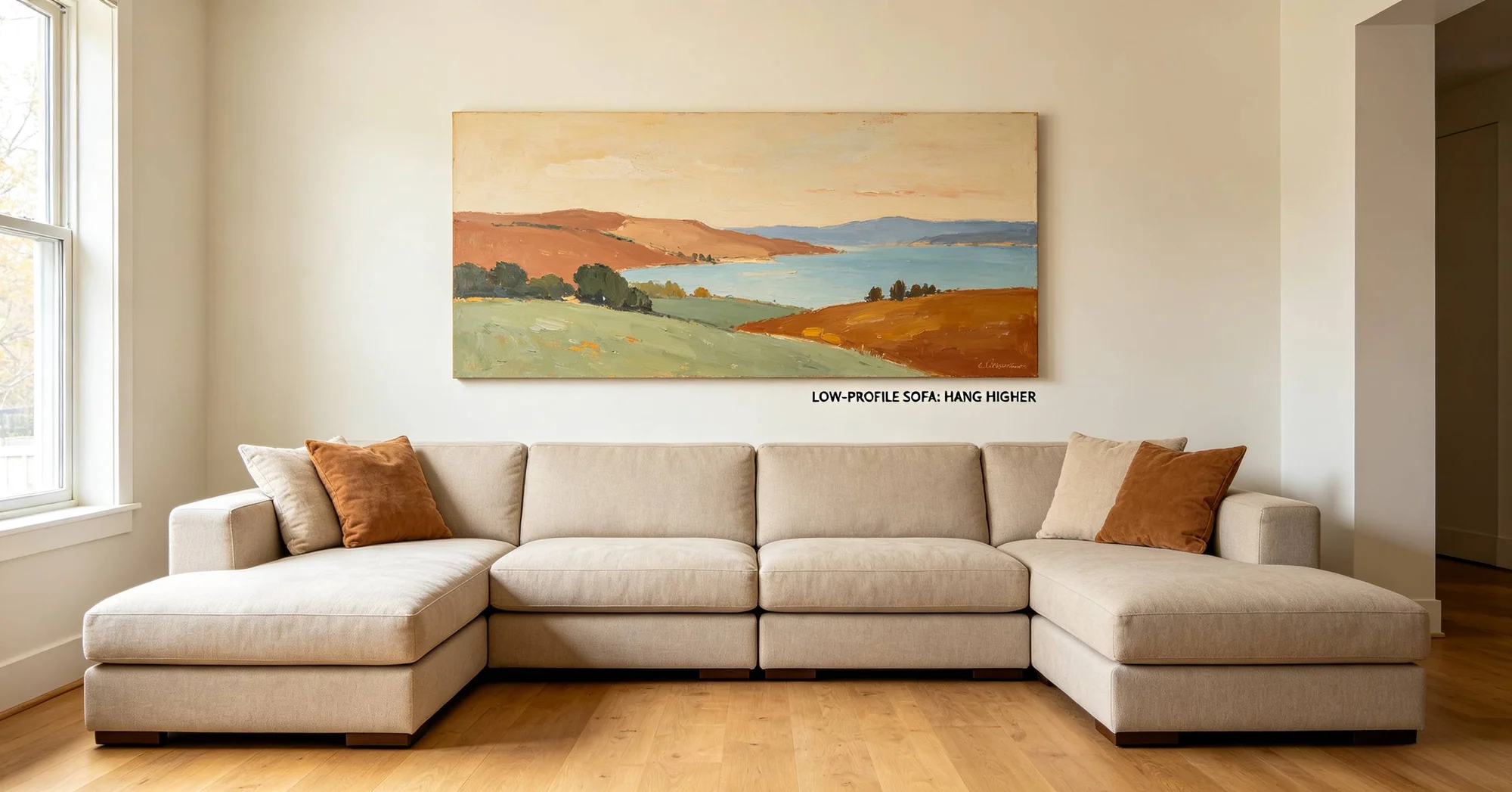
Should canvas art be hung higher above a low-profile couch than a standard one
Learn how sofa height affects canvas art placement. We analyze the 6–8 inch rule, ceiling height, and room proportions with data from 2025 design surveys.