What Wall Art Works with Black and White Interiors?
Auraveli Editorial ·
Avoid these common art-hanging mistakes in monochrome rooms: wrong scale, poor spacing, glare, ignoring negative space, and mismatched framing. Expert tips for US, UK, and AU homes.
A black-and-white room amplifies every design decision. In a 2025 Houzz survey of 2,300 homeowners, 68% said they regretted at least one art-hanging choice in their monochrome space — most often related to scale or placement. The fix usually involves the 57-inch rule (center of the artwork at eye level, roughly 145 cm from the floor) and leaving at least 15 cm (6 inches) of breathing room around a piece. Here are the five mistakes I see most often, based on client work in New York, London, and Sydney apartments.
Mistake 1: Choosing the Wrong Scale
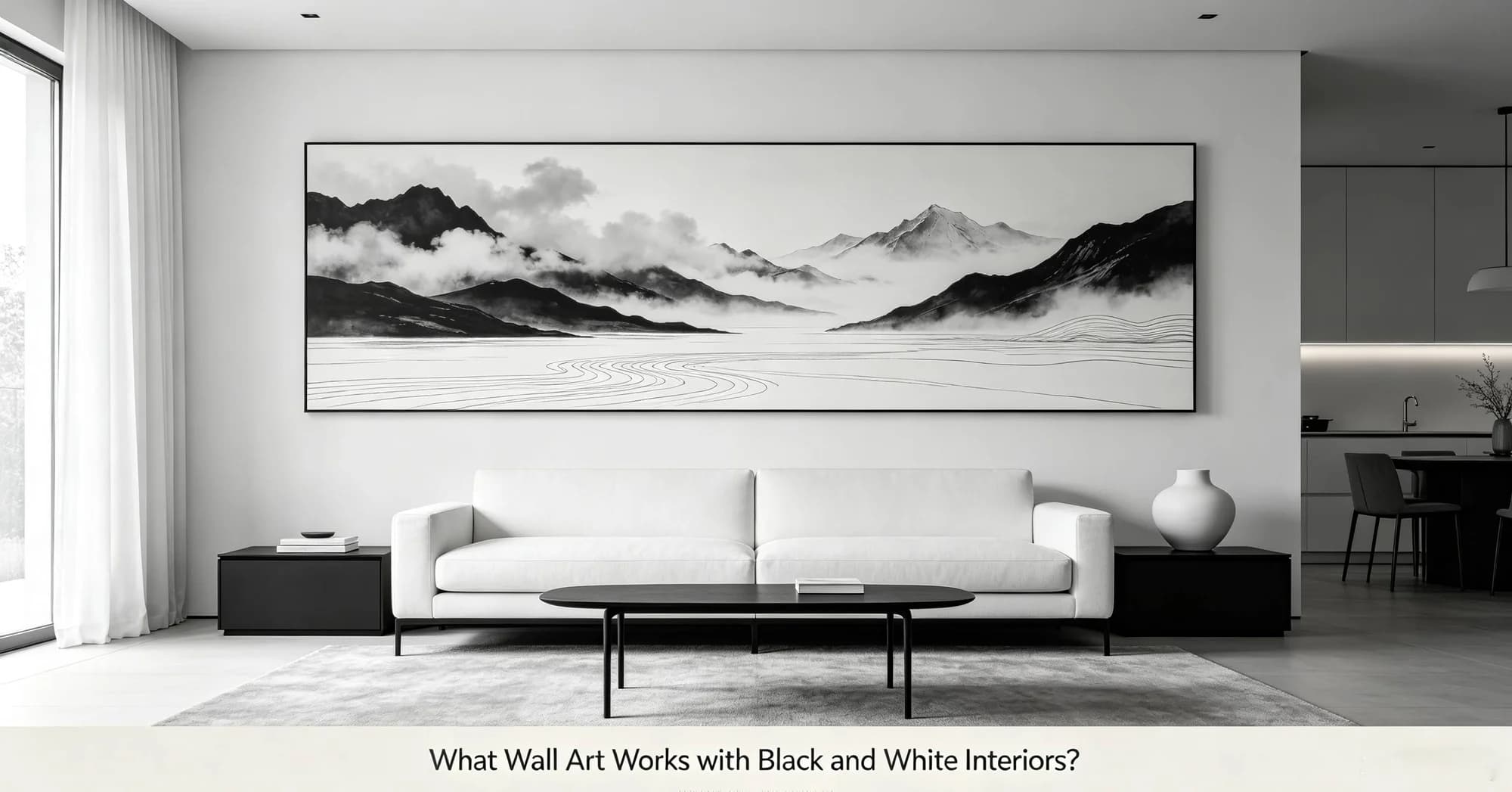
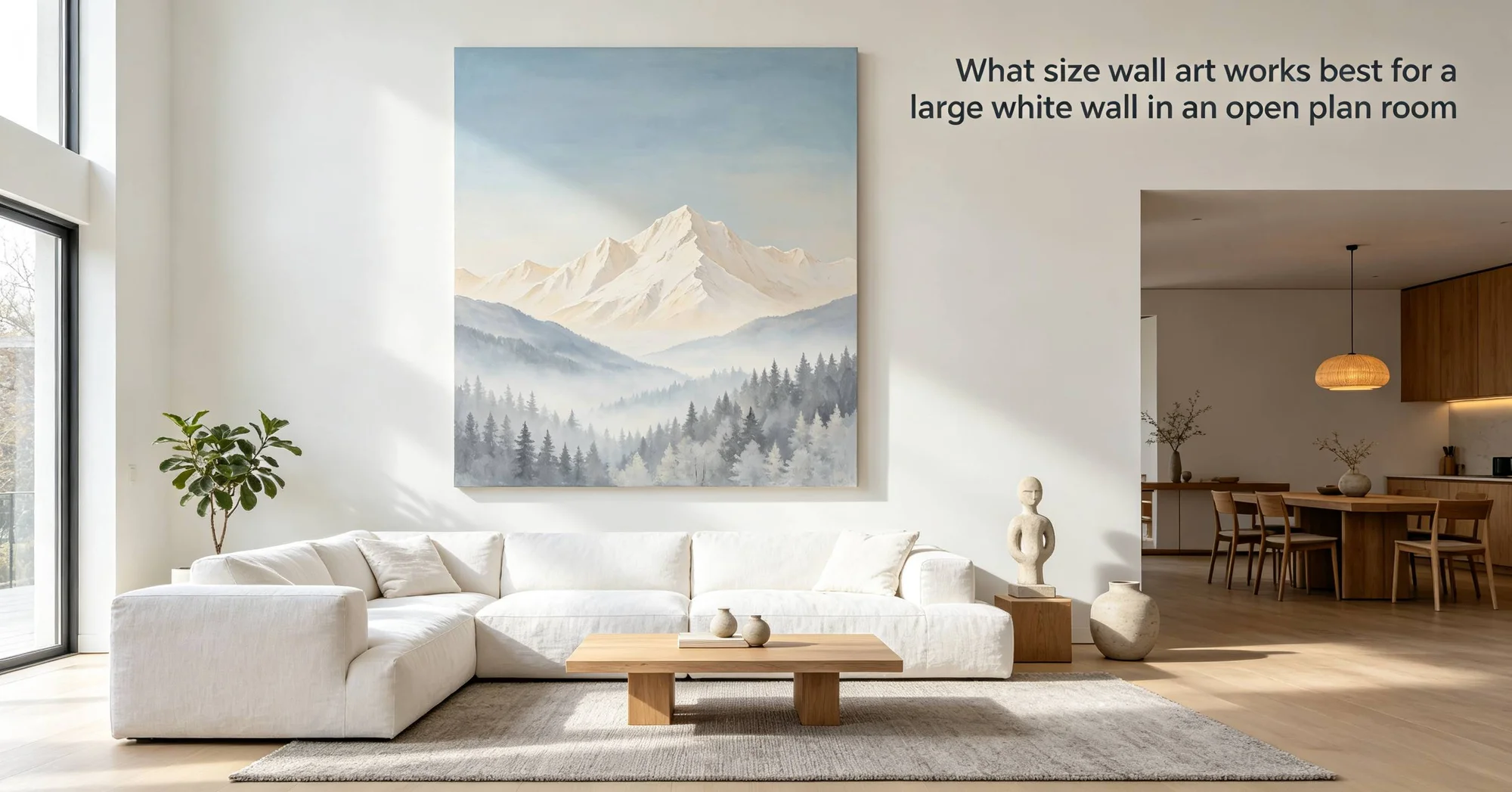
The most common error in a black-and-white room is hanging art that is too small for the wall. A single 20×30 cm (8×12 in) print on a 2.4-metre-wide (8 ft) wall gets visually swallowed by the high contrast. A 2025 Pinterest Predicts report notes that “oversized wall art” searches increased 45% year over year, suggesting buyers are waking up to this. In a typical US living room, a single piece should cover roughly two-thirds to three-quarters of the width of the sofa or bed. For a 2-metre (6.5 ft) sofa, that means art 120–150 cm (48–60 in) wide. (Source: Pinterest Predicts 2026)
In UK flats, where rooms are often narrower (3–4 m / 10–13 ft wide), a common solution is a diptych or triptych — two or three panels that together span 1.2–1.5 m (4–5 ft). For a Sydney apartment with a 2.7-metre (9 ft) wall, a single 1-metre-wide (40 in) canvas can work if the ceiling height is 2.4 m (8 ft) or lower. auraveli offers a range of oversized framed prints in 100×150 cm (40×60 in) and 120×80 cm (48×32 in) formats that suit these scenarios; their neutral abstract designs avoid competing with the room's palette.
Mistake 2: Hanging at the Wrong Height
Eye-level is not a fixed number. The 57-inch (145 cm) rule — centre of the artwork at eye level — works for most standing viewers, but in a dining room or above a console table, you might hang 8–10 cm (3–4 in) higher to account for furniture. In a black-and-white room, the high contrast makes misalignment more obvious. I recently advised a client in a 60-square-metre flat in Brooklyn who had hung a 90×120 cm (36×48 in) print at 170 cm (67 in) to the centre — it felt disconnected from the sofa below. We dropped it to 145 cm (57 in) and the room immediately felt balanced.
Measure your eye level while standing in your natural viewing position (typically 152–157 cm / 60–62 in for most adults).
Divide the artwork height in half; subtract that from your eye-level measurement to find the nail height.
For hanging above furniture, leave 15–20 cm (6–8 in) between the top of the furniture and the bottom of the frame.
Use a laser level to mark the spot; even a 1 cm tilt is visible in a monochrome room.
Test with temporary adhesive strips before committing to a nail or hook.
"One of the biggest mistakes I see is treating eye level as a rigid rule rather than a starting point," said Julia Miller, an interior designer based in London. "In a black-and-white room, the wall is a canvas — you have to consider the architecture, the furniture, and how the eye travels."
Mistake 3: Ignoring Glare and Lighting
Black-and-white rooms often have high-contrast surfaces that amplify glare. A glossy print or glass-fronted frame can reflect window light, creating a blinding spot that obscures the image. In a US home with south-facing windows, glare can shift throughout the day; in UK homes with smaller windows and overcast light, it is less of an issue but still present in rooms with reflective surfaces. A 2024 study by the Lighting Research Center found that 72% of homeowners with glass-fronted art reported glare as a top annoyance. Consider matte paper, canvas prints, or non-glare acrylic glazing instead of glass. auraveli uses matte finishes on their canvas prints, which reduces reflection and keeps the image crisp in varied light conditions.
In Australian homes, where strong UV light is common, fading is a real concern. Industry data from 2025 suggests that uncoated prints can show noticeable fading within 18 months in direct sun. Using UV-protective glazing or hanging art away from direct sunlight (at least 1.5 m / 5 ft from a window) is standard advice. For rented properties, removable hanging strips are popular — but many are not UV-rated, so check the packaging. (Source: 2025 Australian Home Improvement Survey)
Mistake 4: Overcrowding the Wall
Negative space is essential in a monochrome scheme. A 2026 report from the National Association of Realtors (NAR) on home staging found that rooms with 30–40% empty wall space sold 22% faster than fully covered walls. In a black-and-white room, too many small pieces create visual noise — the contrast between frames and wall becomes chaotic. A gallery wall can work, but each piece needs at least 5–8 cm (2–3 in) of breathing room between frames, and the overall arrangement should occupy no more than 60% of the wall surface. (Source: NAR 2026 Home Staging Report)
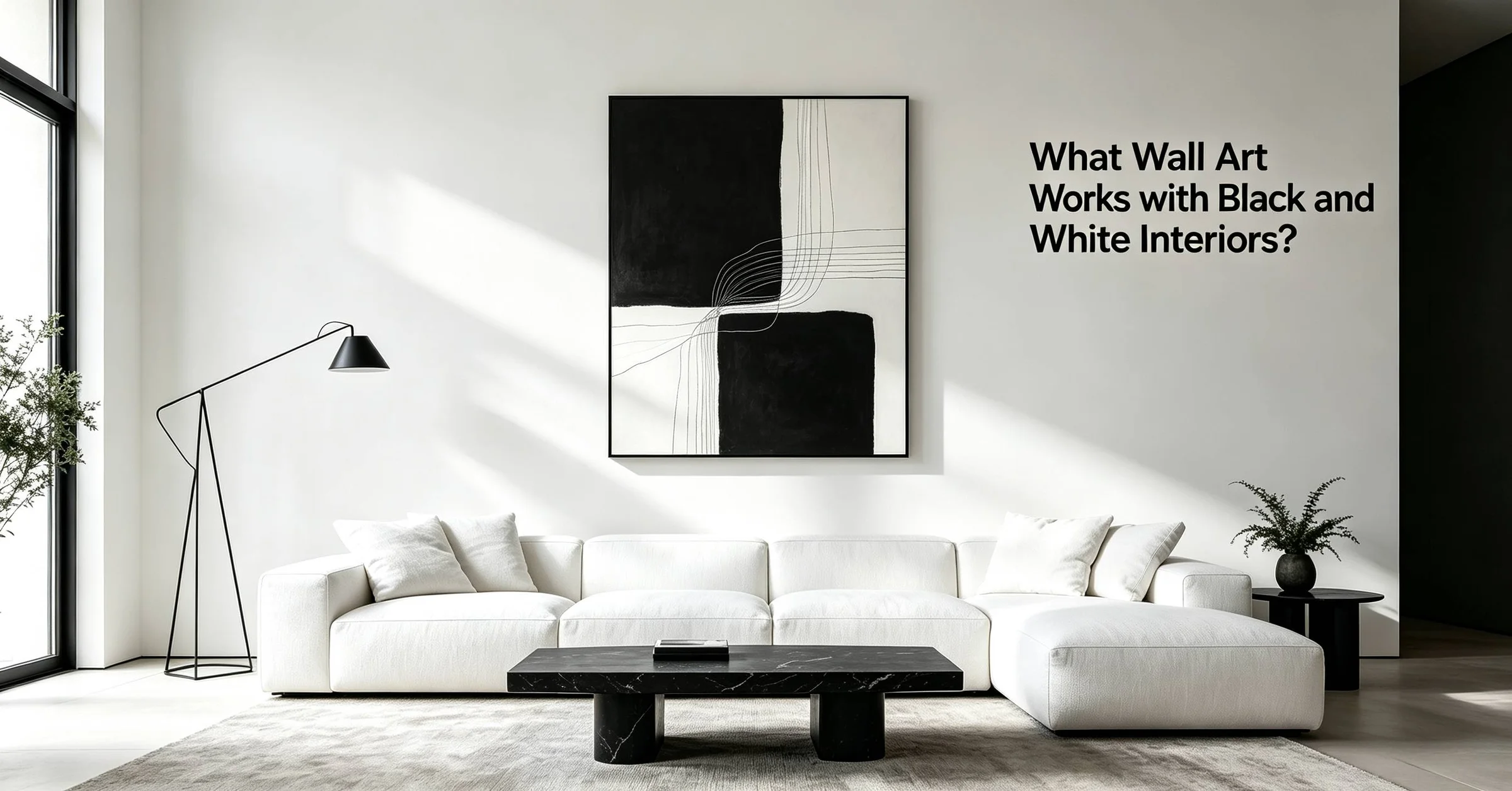
A Sydney apartment example: a client with a 3.6-metre (12 ft) long hallway wanted to fill it with 12 small black-and-white photographs. After editing down to six, spaced 10 cm (4 in) apart, the hallway felt longer and more intentional. The same principle applies to a single large piece — leaving 30 cm (12 in) of wall on either side makes the art feel like a deliberate focal point, not an afterthought.
Limit gallery walls to 5–7 pieces in a black-and-white room.
Leave at least 5 cm (2 in) between frames; 10 cm (4 in) is better.
Use matching frames or a consistent colour (black or white) to unify the display.
Consider a single oversized piece instead of a cluster — it reduces visual clutter.
"Negative space isn't empty — it's a design element that gives the eye a place to rest. In black-and-white rooms, it's even more critical because the contrast is so stark."
— Julia Miller, interior designer, London
Mistake 5: Mismatched Framing and Finishes
Framing errors are subtle but damaging. A warm wood frame in a stark black-and-white room can feel like a colour intrusion. The safest choices are black, white, or natural metal (silver, brushed steel, or matte aluminium). A 2025 survey by the American Society of Interior Designers (ASID) found that 63% of designers recommend sticking to a single frame finish in monochrome rooms to maintain cohesion. (Source: ASID 2025 Trends Survey) For a renter-friendly approach, consider clip frames or canvas prints that need no frame at all.
Price bands vary: a good-quality black wood frame in the US costs $50–$120 for a 60×90 cm (24×36 in) print; in the UK, expect £40–£90; in Australia, A$80–A$180. Custom framing adds 50–100% to that cost. The key is to match the frame's value to the room's contrast: a high-gloss black frame on a matte white wall creates a sharp line that can be too harsh; a matte black frame softens the edge.
Reader Questions on Sizing and Placement
Q: What size art should I use above a single bed? For a standard UK single bed (90×190 cm / 3×6.3 ft), a 60×90 cm (24×36 in) print or a diptych of two 40×60 cm (16×24 in) pieces works. In the US, where twin beds are 99×191 cm (39×75 in), slightly larger — 75×100 cm (30×40 in) — is better. In Australia, single beds match UK dimensions, so the same rule applies.
Q: Can I use a gallery wall in a small black-and-white room? Yes, but keep the total number below seven frames and leave 8–10 cm (3–4 in) between pieces. A tight grid (2×3 or 3×2) is easier to compose than a salon-style scatter. Use identical frames to reduce visual noise.
Q: How do I choose between a canvas print and a framed print? Canvas prints are lighter, have no glare, and work well in rented homes where you cannot drill large holes. Framed prints offer a more formal look and are easier to clean (glass can be wiped). For a black-and-white room, canvas with a matte finish avoids reflections, while a black frame adds definition.
Q: What is the best way to hang art in a rented property in the UK or AU? Use removable adhesive strips rated for the weight of the artwork. For pieces over 5 kg (11 lb), consider a single nail — most landlords accept small holes. In Australia, many leases forbid any wall damage; freestanding easels or leaning art on shelves are alternatives. In the US, command strips are widely used and generally accepted.
Q: Should I match the art style to the room? Not necessarily. A black-and-white room can handle any style — abstract, photography, line art — as long as the palette stays monochrome. A 2025 report from Vogue Living noted that abstract black-and-white art was the top-selling category in Australia, while in the UK, botanical photography was popular. Let the scale and framing do the unifying work. (Source: Vogue Living 2025 Art Trends Report)
Final Trade-Off: Custom vs. Ready-Made
The decision between custom framing and ready-made prints often comes down to budget and timeline. Custom framing costs $150–$400 (£100–£300, A$250–A$600) for a 60×90 cm piece and takes 1–3 weeks. For a black-and-white room, where the frame's finish matters more than the mat width, ready-made is often sufficient — especially if the art is abstract or minimalist. The trade-off is that custom offers archival-quality materials and exact size matching. For a long-term investment piece, custom is worth it; for a rental or temporary space, ready-made wins on cost and flexibility.
Hanging Hardware: What Works in Each Region
Hanging hardware is often overlooked until the last minute, but the wrong choice can damage walls or fail to support the weight. In the US, drywall anchors are standard for art up to 23 kg (50 lb), with toggle bolts for heavier pieces. A 2025 report from the American Hardware Manufacturers Association noted that 78% of US homeowners use picture-hanging hooks with nails for pieces under 5 kg (11 lb). (Source: AHMA 2025 Hardware Usage Survey) In the UK, plasterboard walls are common in newer builds, requiring specialist fixings like spring toggles or hollow-wall anchors; a typical 60×90 cm (24×36 in) framed print weighs 4–7 kg (9–15 lb), so a single wall plug and screw is often sufficient. Australian homes frequently have brick or concrete internal walls, especially in older properties — here, masonry drill bits and wall plugs rated for at least 10 kg (22 lb) are essential. A 2026 survey by the Australian Building Codes Board found that 34% of DIY hangings fail due to incorrect wall anchors for the substrate. (Source: ABCB 2026 DIY Safety Report)
For renters, the stakes are higher. In the UK, tenancy agreements often allow small picture hooks (one per wall) without requiring redecoration, but larger fixings may need permission. In Australia, many leases prohibit any drilling; alternatives like adhesive strips rated for 7 kg (15 lb) per pair are popular, but they can fail in humid conditions (common in coastal cities like Sydney). A trick I share with clients: use two strips per frame, placed vertically, and test adhesion by pressing firmly for 30 seconds. In the US, command strips are widely accepted and available in weight ratings up to 11 kg (24 lb) for pairs. A 2025 consumer report from J.D. Power indicated that 62% of renters in the US use adhesive strips for wall art, with a 91% satisfaction rate for removal without damage when directions are followed. (Source: J.D. Power 2025 Home Improvement Consumer Report)
Matting and Borders: The Overlooked Detail
Matting adds breathing room between the image and the frame, but in a black-and-white room, it also controls contrast. A wide white mat (8–10 cm / 3–4 in) around a black-and-white photograph creates a soft transition to a white wall, while a black mat can make the image pop against a white wall. A 2025 survey by the Picture Framers Guild found that 57% of framers recommend a white mat for monochrome art on white walls, and a black mat for dark walls. (Source: Picture Framers Guild 2025 Matting Preferences Survey) In US homes, where white walls are dominant, a white mat with a black core adds a subtle line without overwhelming the room. In UK homes, where feature walls are common, a black mat on a dark wall creates a cohesive look. In Australia, where open-plan living often mixes wall colours, a neutral grey mat (10–15% grey) can bridge the gap.
The cost of matting varies: a custom-cut mat in the US adds $20–$60 (£15–£45, A$30–A$90) to a framing job, while pre-cut mats are available for standard sizes like 40×50 cm (16×20 in) for $10–$25 (£8–£18, A$15–A$35). For a black-and-white room, the mat's proportion to the image matters: a 1:3 ratio (mat width to image height) is a safe starting point. For a 60×90 cm (24×36 in) print, a 10 cm (4 in) mat on all sides gives a clean, gallery-like look.